
4 March @ 6:00 pm – 7:30 pm
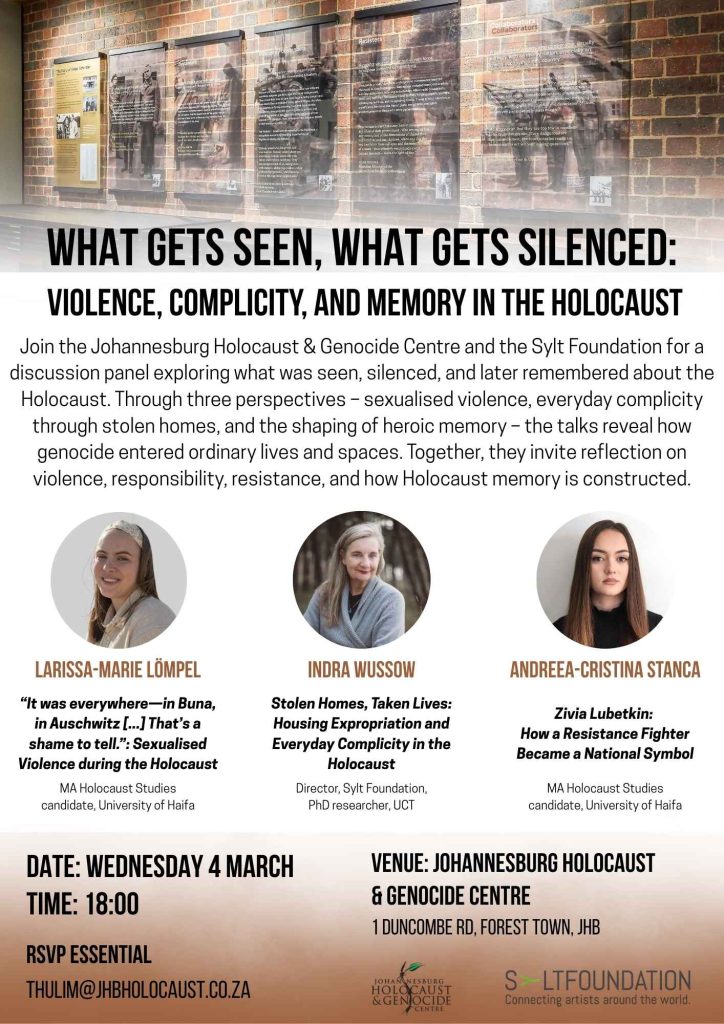
Join the Johannesburg Holocaust & Genocide Centre and the Sylt Foundation for a discussion panel exploring what was seen, silenced, and later remembered about the Holocaust. Through three perspectives – sexualised violence, everyday complicity through stolen homes, and the shaping of heroic memory – the talks reveal how genocide entered ordinary lives and spaces. Together, they invite reflection on violence, responsibility, resistance, and how Holocaust memory is constructed.
“It was everywhere—in Buna, in Auschwitz […] That’s a shame to tell.”: Sexualised Violence during the Holocaust – Larissa-Marie Lömpel
“It was everywhere! In Buna, in Auschwitz … That’s a shame to tell.“ With these words, Sam Lubat captured both the pervasiveness of sexualised violence during the Holocaust and the silence that long surrounded it. This talk discusses both dimensions.
Drawing on recent scholarship, it maps the contexts in which sexualised violence occurred under National Socialist rule: from the mass shootings and pogroms in the occupied East to the ghettos, hiding spaces, and concentration camps of Nazi-ruled Europe. It examines the range of perpetrators – SS personnel, Wehrmacht soldiers, allied forces, and civilians – as well as the complexity introduced by cases of victim perpetration. The lecture then turns to historiography, asking why sexualised violence remained at the margins of Holocaust scholarship for so long. It traces how survivors navigated cultural taboos and institutional barriers when attempting to speak about their experiences, and how scholars – shaped by similar constraints and by a universalised narrative of the Holocaust that left little room for gendered analysis – were slow to engage with the subject. By examining both the phenomenon and its fraught reception in testimony and scholarship, the lecture contributes to an ongoing effort to bring sexualised violence into focus as a distinct and indispensable dimension of Holocaust history.
Larissa-Marie Lömpel holds a BA in History and Gender Studies from the University of Göttingen and is currently completing an MA in Holocaust Studies at the University of Haifa. Her research interests include gendered violence, perpetrator–victim relations, and the intersections of historical scholarship and public memory. Her MA thesis examines sexualised violence in the Auschwitz camp complex. Alongside her studies, she has been actively involved in Holocaust education and remembrance. During her undergraduate years, she worked as a guide at the Bergen-Belsen and Moringen memorial sites and completed several internships in Germany and abroad. In 2024/25, she worked as a researcher at the Anne Frank House.
Stolen Homes, Taken Lives: Housing Expropriation and Everyday Complicity in the Holocaust – Indra Wussow
This seminar is based on Wussow’s PhD research on German Baltic settlers resettled by the Nazi regime into Łódź (Litzmannstadt), one of the central administrative sites of the Holocaust in occupied Poland. The talk examines housing expropriation as a key mechanism through which genocide entered everyday life.
At the centre of the seminar is a microhistorical case study: the appropriation of a Jewish family’s apartment by Bruno Carlhoff, a resettled Baltic German who entered the Nazi administration in Łódź. Through archival material including housing files, administrative records, and later testimony, she reconstructs how the Ajzen family was dispossessed of their home, and how that same space was subsequently occupied and normalised by its new German inhabitants.
Focusing on one apartment allows us to follow the Holocaust at a human scale: how removal, reassignment, and occupation were organised; how violence was translated into paperwork; and how perpetrators learned to live comfortably inside stolen spaces. Housing emerges here not as a marginal detail, but as a central site of moral and material transformation—where racial entitlement was made tangible through rooms, furniture, and everyday routines.
Using microhistory as a method, the seminar shows how complicity developed not primarily through ideological fervour or overt cruelty, but through institutional permission, emotional adjustment, and the acceptance of “normal” advantages produced by persecution. By placing a perpetrator and a victim family in the same spatial frame, the talk foregrounds the intimate proximity of genocide and challenges abstract understandings of participation in Nazi crimes.
The seminar offers an archive-based, concrete perspective on how the Holocaust was lived, enacted, and normalised in cities like Łódź and why attention to stolen homes remains crucial for understanding responsibility, memory, and loss.
Indra Wussow is a psychologist and Holocaust researcher working at the interface of history and psychology, currently completing a PhD on everyday complicity in Nazi-occupied Łódź. She is the director of the Sylt Foundation, and holds a MA in Holocaust Studies from the University of Haifa and a MA in Narrative Therapy from the University of Melbourne.
Zivia Lubetkin: How a Resistance Fighter Became a National Symbol – Andreea-Cristina Stanca
How does a young woman who fought in the Warsaw Ghetto Uprising become a symbol for an entire nation? And what gets lost when a human life is turned into a heroic myth?
This presentation explores how the public memory of Zivia Lubetkin was shaped in the first decades of the State of Israel, and how her story became central to a heroic model of Holocaust remembrance. Drawing on Lubetkin’s memoir and scholarship on Holocaust memory and Israeli nation-building, the lecture shows how her image was mobilised to promote ideals of resistance, strength, and Zionist renewal at a moment when Israeli society was seeking unifying symbols. In this process, armed resistance was elevated as a moral ideal, while many other survivors experiences marked by vulnerability, coercion, and “choiceless choices” remained marginalised.
The conversation also traces the shift brought about by the Eichmann Trial, when survivor testimonies reshaped public understanding of the Holocaust and complicated earlier myths of heroism. By returning to Lubetkin not only as a fighter but also as a woman who resisted the Nazis, becoming a public icon and carrying her trauma into postwar life, this talk argues for a more honest and humane memory culture, one that remembers courage without erasing suffering and resistance without turning people into symbols.
Andreea Stanca is engaged in her MA in Holocaust Studies at Haifa University, focusing on Zionism, Holocaust education, antisemitism, and Holocaust memory. She has published widely and is currently working on an article on political antisemitism in Romania. She is currently an intern at the Johannesburg Holocaust & Genocide Centre.